
Whenever there is a Federal Open Market Committee (FOMC) meeting there is constant speculation on what will be said and what clues will be provided as to whether interest rates will be changed. The expectation is that these rates changes will impact long term rates and subsequently the market and the economy. There is certainly truth to this line of cause and effect, but what is most important to remember and has been perfectly illustrated this year is that the bond market is the real determinant of where long-term interest rates are going regardless of what the Federal Reserve does. The following graph shows the interest rates for the 30-year bond for the U.S., France, Japan and Germany. What is clear is that rates are moving higher in all those areas and that could become problematic at some point soon.
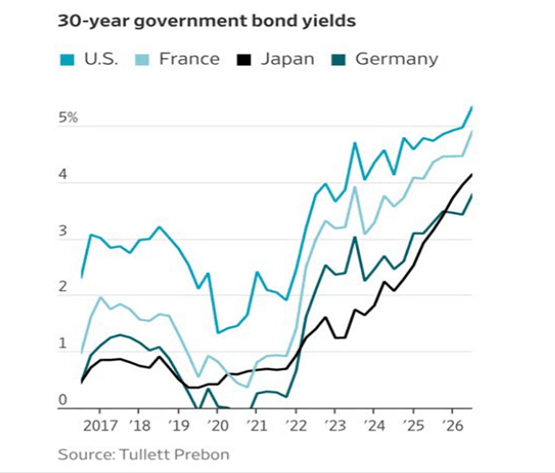
Let’s first start with why this is occurring, and there are several reasons. In all 4 countries the amount of government debt continues to increase. In the U.S. we just crossed the $40 trillion mark in federal debt with an additional $2 trillion to be added this year. The annual interest paid on the U.S. debt is well over $1 trillion and is bigger than all defense spending. All these countries have an ageing population that needs more services and are not paying much in the way of taxes. Unfortunately, the imbalance between tax receipts and spending will probably only get worse, putting more pressure on long-term rates to move higher. The other issue you have globally but especially in the U.S. is many corporations are issuing large amount of debt to compete in the global AI race. This additional debt is causing interest rates to increase across all categories including government debt.
So how do these rising interest rates impact the markets and the economy. Starting with consumers, the interest rates for mortgages and credits cards will also move higher causing housing prices to plateau and impacting consumer spending. Interest rates on business loans have also increased, impacting the ability of small businesses to expand and fund capital expenditures. With the 30-year US Treasury rate moving above 5% for the first time since 2007 the stock market is concerned that it could impact future profits and spending on AI and the market has retreated over the past several days.
With all that has been said regarding rising interest rates and the fact that they seem so high it is important to remember that the current rates are actually in a more normal range from a historic perspective. The graph below shows the 30-year mortgage rate for the past 50 years and it’s evident that current rates are in the middle of the range and the truly unusual time was the 2010s when rates were so far below average.
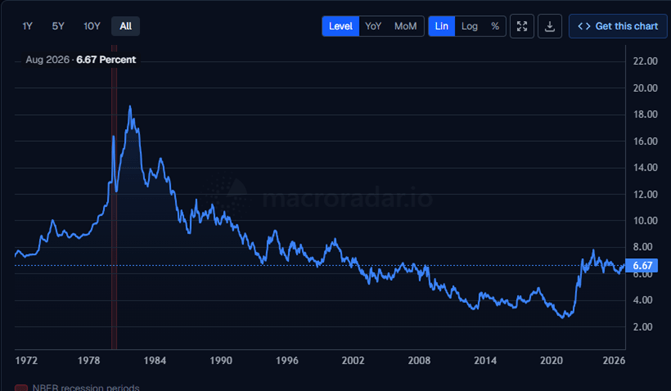
Where we go from here is anyone’s guess but there are a few scenarios that seem very likely. If long dated interest rates continue to climb and inflation remains elevated, the Federal Reserve will be forced into raising rates or otherwise they risk looking inept. Also, at some point we’ll need to deal with issues such as the solvency of social security, Medicare and the ever-increasing government debt and it will require a combination of cutting spending and increasing taxes – two things that are unfavorable with most voters.