Being a wealth manager, when I’m at social gatherings, I’m frequently asked the question, “What is the number you need to have to retire?” I understand the reason for the question. People like simple answers to complex situations. But given the complexity of topic I usually make a lighthearted joke that it’s always 20% more than whatever they have today. If they are sincere in their question, then I always turn the question around as to what is important to them and how do they envision their retirement. But to get to the right answer there are several questions that need to be answered which I have highlighted below.
First, one of the biggest variables of how much you need to retire is when do you want to retire. If you are open to working even part time until you are in your 70s (which many people do these days) your number is much different than if you want to fully retire in your mid-50s.
Second, you need to be able to answer the question, how much do you want to spend in retirement? Are you looking to sit on the porch and enjoy watching the birds or do you want to travel around the world on Ritz Carleton cruises. How you answer this question could dramatically change your number.
Third, do you want to leave a legacy to children or charities or are you okay with spending down your assets. The 4% distribution rule from a portfolio allows you to take cash flow from your accounts while allowing them to grow for inflation. Under most market conditions, at that distribution level, there will likely be sizable assets left for the next generation. If someone is not interested in leaving a legacy, you can push the distribution rate closer to 6% and potentially have less assets saved to provide the cash flow you need.
There are also many other variables that impact your number including do you have a pension, is your mortgage paid off, and do you have long-term care insurance and/or health care insurance.
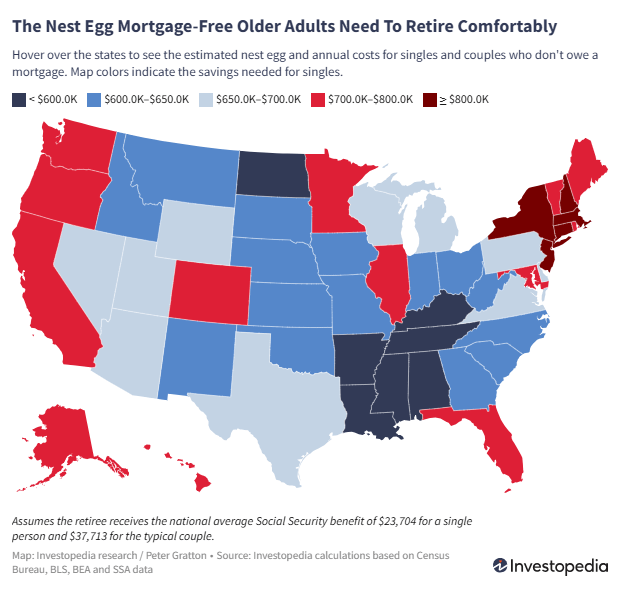
Another big variable is where do you live? Investopedia recently had an article where they discussed the average size of the nest egg needed to retire by state (graph shown below). But as is often the case when discussing averages, it doesn’t provide much insight. The graph shows New York state as one of the most expensive places to retire but the actual expense numbers will vary dramatically if you live in NYC vs Upstate NY. The map has Tennessee as one of the cheapest states to retire in but that will also very dramatically if you live in Nashville vs in a rural area.
Finally, your comfort level with risk also comes into play as it will impact the asset allocation of your portfolio and in turn the rate of return on your portfolio. If you mostly want to be in cash and conservative asset, you’ll need a larger nest egg to provide a 4% distribution rate over time and adjust it for inflation. If you are okay with 60% in stocks, then your retirement number can be smaller because your long-term growth will be greater.
I’m a big believer in good communications and it’s through good conversations that you get good answers. I always tell clients when we start discussing long-term retirement planning that it should be a fun and rewarding discussion where they and their partner do some real soul searching to determine the correct path. Most people have worked for many years to get them to this spot and if they have their health and are in a reasonably good financial position this will be some of the best years of their life.