
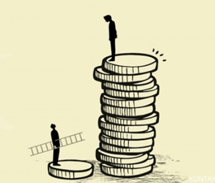
The economy has achieved a soft landing, and broad economic data continues to excel. A long list of positives, including stock markets at all-time highs, strong wage growth, impressive job creation, low unemployment, declining inflation, and a resilient real estate market, paints a bright picture. In theory, this should be an economy where people are celebrating, yet general consumer sentiment tells a different story. Instead of optimism, there is widespread concern about households’ ability to pay bills and maintain their economic status.
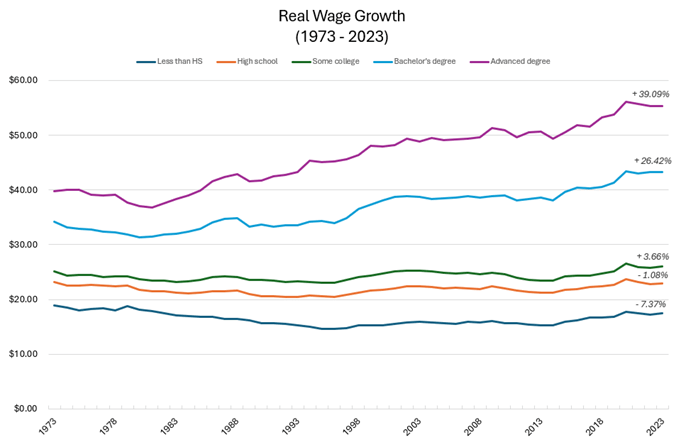
This frustration, however, is not evenly distributed across all households but is concentrated among families at the lower end of the income spectrum. Several factors contribute to this disparity. One of the most significant is wage growth. As shown in the chart below, real wage growth (adjusted for inflation) over the past 50 years has been negative for those with limited education. In contrast, individuals with advanced degrees have experienced a 39% increase in real wages, while those with college degrees have seen a 26% rise.
Source: Economic Policy Institute
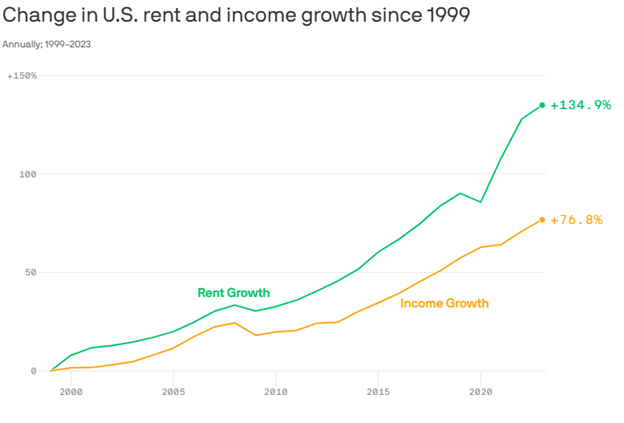
On the cost side, many individuals and families with lower incomes are renters rather than homeowners. The chart below illustrates how rent growth has substantially outpaced income growth over the past 23 years. Higher-income earners, who are more likely to own homes, have benefited from significant increases in real estate values over the past 25 years, with some of the most dramatic price hikes occurring in the last four years. This surge in home values, along with a 15-year bull market, has caused the net worth of higher-income households to balloon, especially over the past few years.
Source: Moody’s Analytics CRE, Axios Visuals
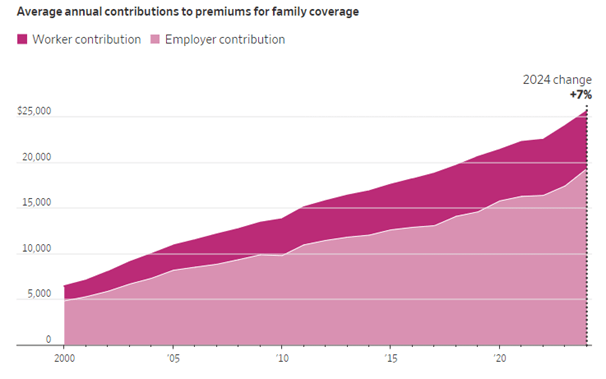
Another major cost increase that has affected all families, but disproportionately impacts lower-income households, is the rise in healthcare costs. As the chart below shows, both worker and employer health insurance premiums have more than tripled in the past 25 years. This represents yet another financial burden on lower-income families, squeezing their standard of living and adding to their financial stress.
Source: Wall Street Journal
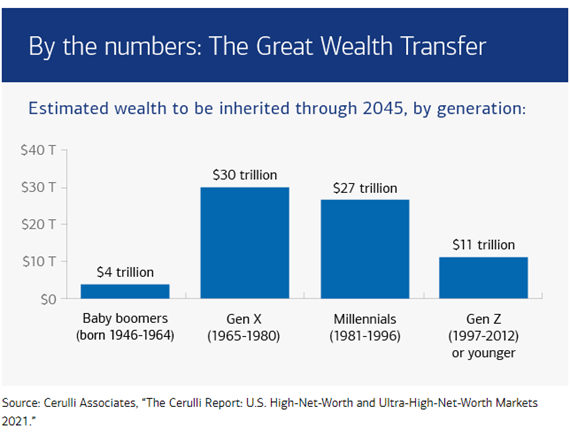
All these data points clearly show that the U.S. economy, and people’s perception of it, is bifurcated between lower-income and higher-income households. Unfortunately, there are few factors that seem likely to improve this situation, and several that could make it worse. These include the rise of artificial intelligence and the $84 trillion in assets that are projected to be transferred between generations within higher-income households over the next 20 years, as outlined in the table below.


 peaceofmindeconomics.com