

On Friday, August 23rd Federal Reserve Chair Jerome Powell stated that it was now time for the Fed to pivot from focusing primarily on its mandate of price stability (AKA inflation) and instead focus more on their other mandate of full employment. This change would occur by them lowering the federal funds by 0.25%, at the minimum, in September.
The market reacted very positively to the news as it has been anticipating and forecasting rates cuts as early as this past winter. The question to ask is, is this rate cut a good news indicator for the markets and a continuation of the soft landing? or does it portend real concerns about the economy?
Stating the Obvious
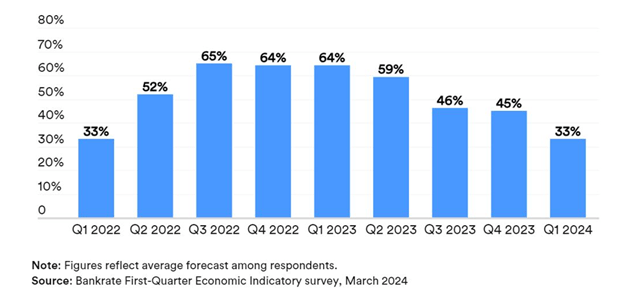
Let’s start by saying that we don’t know. That may sound obvious, but this lack of insight doesn’t prevent forecasters from trying to predict the likelihood of a recession. The chart below shows economists’ forecasted odds of a recession over the past two years – and how wrong their predictions were!
Forecasted Odds of Recession in the Next 6 Months Q1 2022 – Q1 2024
Lots of Reason for Optimism
There are clearly a number of factors indicating that this economy will continue to thrive and avoid a recession including the following:
- The advent of artificial intelligence (AI), which improves profitability and productivity for companies and also drives trillions of dollars of investment. You can learn more about my thoughts on artificial intelligence in one of my earlier blogs “Artificial Intelligence – The Engine to Drive Growth in the Markets and the Economy”.
- Historically, economic expansions do not end because of old age but instead there are usually several catalysts the cause them to stop. With the exception of geopolitical issues, there are no apparent vulnerabilities or asset classes that could be in bubble valuations like we saw in 2000 and 2008.
- Investor and consumer caution has been very high and the $6 trillion in money market funds and strong corporate balance sheets provide a good tail wind for future economic growth.
- The housing market, with its large supply shortage and current stable prices, this sector will greatly benefit from lower rates and be a driver behind economic growth.
What Drives the Concerns about the Economy
We are in an important stage of determining whether Jay Powell has been successful with implementing the soft landing. If over the next 6-12 months he can keep inflation heading to 2% and keep the economy reasonably strong, he will have completed something that hasn’t been done before: increasing the federal funds rate dramatically (500 basis points) in a very short period of time and not causing a recession. And the significant nature of this achievement is why there is so much concern regarding the economy.
When economists look at a yield curve that has been inverted for more than 18 months their minds race to recession fears because that is what the historical data indicates. The data shows (see graph below) that it is not uncommon for the unemployment rate to stay low for an extended period of time. However, when it starts moving higher, it moves quickly and usually indicates the start of a recession. This is the basic idea of the Sahm rule which you have probably heard about in the media
Historical Unemployment Rate (blue line) and Recession (gray)

Where you Should be Focused
The important thing to remember is just like bear markets are part of investing and will never go away, recessions are part of the economic cycle, and one will happen eventually. Rather than trying to predict and time the next recession, it is more important to have your finances and investment portfolio strategically managed to handle any challenges that may arise with the next recession – even if it comes unexpectedly.
The other important takeaway is that not all recessions are as dramatic as 2000 and 2008. In 1990, there was a recession in which the S&P 500 declined by 6.56%. The following year, in 1991, the market was up 26.2%.
If you have any questions regarding this article or any other finances questions you can contact our firm at www.bouchey.com.



 peaceofmindeconomics.com